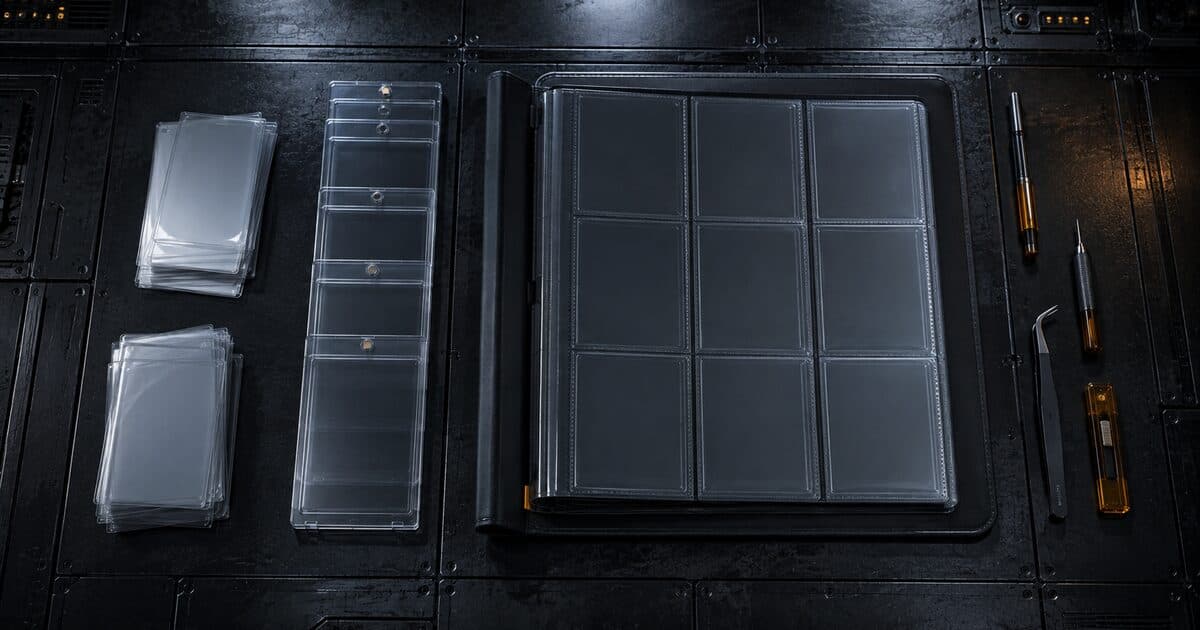
How to Store Your Gundam Cards: Sleeves to Binders
Sleeves, top loaders and binders for a Gundam Card Game collection: what to protect, what to leave in the box, and the products we use for our own cards.
Gundam cards are standard 63.5x88 mm trading cards, the same size as Pokemon and Magic cards, so none of the storage advice here is exotic and none of the products are hard to find. What is worth deciding is which cards get which level of protection. Sleeve everything the same way and you either waste money on commons or underprotect the versions that carry your collection's value.
This is how we store our own cards. The product links on this page are Amazon affiliate links (the disclosure page has the details), and every product on it is one we actually use.
Triage first: not everything earns a sleeve
Sort a fresh box into three piles. Bulk commons and uncommons you will never miss can live unsleeved in the box they came in or a plain storage box; they cost less than the sleeves would. Cards headed for the binder get a single sleeve. And the top of the set gets the full treatment described next: the plus and double plus versions (the scarce alternate art cards, marked + or ++ after their rarity) that would really hurt to replace.
If you are unsure where a version falls, its card page here shows tonight's market price, and each set's page lists its most valuable versions. Let the market do the triage.
Double sleeve the cards that matter
The standard for a valuable card is two layers. A tight inner sleeve, sold as "exact fit", hugs the card and seals the top. A standard sleeve goes over it the other way up, so nothing can slide in from either direction. It sounds fussy the first time and takes about ten seconds per card once you have done a few.
Vault X Exact Fit Inner Sleeves (500)
The snug inner layer for double-sleeving. Acid free and archival safe, and 500 of them lasts a long while.
Amazon affiliate link
Dragon Shield Matte Sleeves (standard size)
The standard outer sleeve. This link is their full standard-size range; pick whichever colour suits the binder.
Amazon affiliate link
The matte finish is a taste call, but it is the one we use: it handles better in a binder pocket and does not show fingerprints the way gloss does.
Top loaders, for cards that travel
A top loader is a rigid plastic case for a single sleeved card. Binder cards do not need one. Anything you trade, sell, post or carry around does, and so does a valuable card that has not found its binder home yet. Put the card in a sleeve first: a bare card rattling in a top loader picks up edge wear, which defeats the point.
Cardboard Gold Top Loaders, 35pt (200)
Rigid protection for a single card in deep storage or the mail. The 200 count works out far cheaper per card.
Amazon affiliate link
The binder is the collection
A side-loading binder with a padded cover is the difference between storing a collection and being able to enjoy one. Side-loading pockets matter more than any other feature. Cards cannot fall out when the binder is carried upright, which is how binders get carried.
Gundam collectors mostly run 12 or 16 pocket pages rather than the 9 pocket pages Pokemon trained everyone on, and there is a practical reason: a playset is four copies, and a four-wide page keeps each playset on its own row. Sets here are compact enough that a single binder holds a whole master set (one of every version) with room to grow.
Dragon Shield Card Codex 576, Iron Grey
Side-loading 12-pocket display binder with a strap closure. Holds 576 cards.
Amazon affiliate link
Vault X 12-Pocket Exo-Tec Zip Binder
Side-loading 12-pocket zip binder, 480 cards. The one for a collection that leaves the house.
Amazon affiliate link
The strap-closure Codex is the right default for a display binder that lives on a shelf; the zip binder is the one for a collection that travels. A word of warning from our own shopping: good binders sell out constantly, 16 pocket sizes worst of all. If neither listing above has stock in the colour you want, go straight to the maker's storefront rather than a lookalike from a brand you have never heard of.
Vault X on Amazon
Their full binder and sleeve range. Binder stock rotates constantly; this is where to look when a size above is sold out.
Amazon affiliate link
The boring rules that do the most work
Keep binders vertical on a shelf like books, never stacked flat, so page weight does not press patterns into the cards. Keep everything out of direct sunlight, which fades foils faster than any handling will. Avoid attics, garages and anywhere else with big temperature and humidity swings. Ordinary living-room conditions are fine. None of this costs anything and all of it matters more than brand choices.
Leave gaps for the cards you are missing
Almost every collector here leaves an empty pocket where a missing version belongs, so the binder shows the shape of the finished set. Hangar is built around that habit. The binder planner lays out any set at 9, 12 or 16 pockets in your chosen order and shows exactly which pocket each version goes in. With a free account you can print placeholder slips for the gaps, so every empty pocket names the card it is waiting for.
Plan the pages before you sleeve anything. Re-sorting a half-filled binder is the storage chore nobody does twice.
We last checked the facts on this page on .